
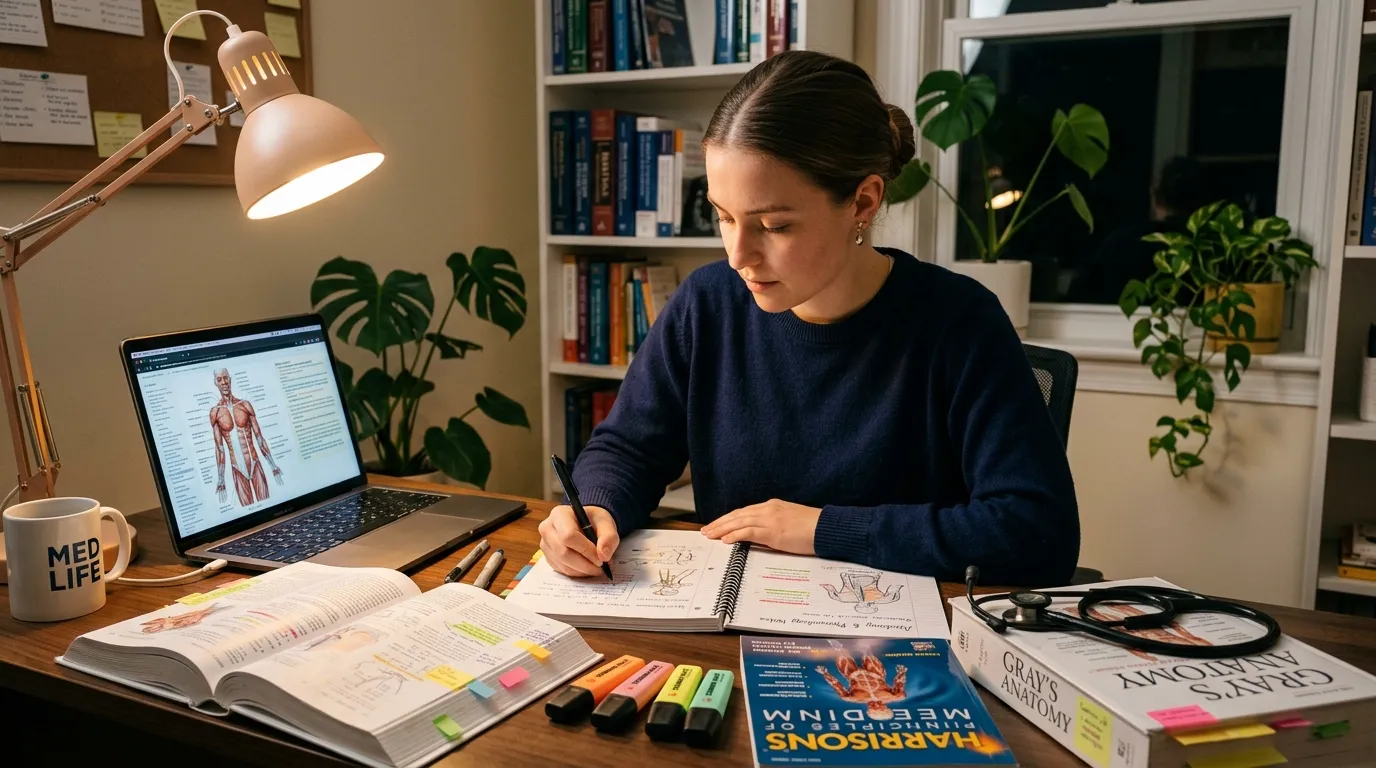
How to Study Medicine Effectively requires more than just long hours of reading. Successful medical students use active learning techniques, spaced repetition, practice questions, and organized study schedules to improve understanding and retention. By combining evidence-based study methods with consistency and self-care, students can manage complex medical subjects more efficiently and achieve better academic performance.
To study medicine effectively, replace passive reading with active recall and spaced repetition, use tools like Anki for memory, apply clinical correlates to deepen understanding, and protect your sleep and well-being. These evidence-based medical school study tips help you retain more while studying less.
Medical school throws an avalanche of information at you. Thousands of pages, hundreds of drug names, endless pathways—all packed into a few short years. The students who thrive aren’t always the smartest in the room. They’re the ones who know how to study medicine effectively.
The truth is, most students arrive at medical school using study habits that worked in high school or undergrad. Rereading notes. Highlighting textbooks. Cramming the night before. These methods feel productive, but research shows they fail when the volume of material explodes. That’s where smarter, science-backed strategies come in.
This guide walks you through the best way to study medicine, from the foundational principles of learning to subject-specific tactics for anatomy, pharmacology, and clinical rotations. You’ll discover effective study methods for medical students, the digital tools that save hours, and the habits that keep burnout at bay. Whether you’re a first-year or prepping for board exams, these medical school study tips will help you work smarter, not just harder.
What Are the Foundational Principles of Effective Medical Study?
 Before diving into subject-specific tactics, you need to understand how learning actually works. Strong foundations make every other strategy more powerful.
Why Is Active Learning Better Than Passive Learning?
Passive learning means absorbing information without doing much with it—rereading notes, watching lectures, or highlighting text. It feels comfortable, but the brain forgets most of it within days.
Active learning forces your brain to retrieve and use information. Instead of rereading a chapter on the cardiac cycle, you close the book and explain it from memory. This struggle to recall strengthens neural connections and locks knowledge in for the long term.
Active recall is the single most powerful study technique for medical students. Here’s how to use it:
- Flashcards: Test yourself on facts, mechanisms, and definitions. Tools like Anki make this systematic and digital.
- Practice questions: Answer questions before you feel “ready.” Getting them wrong teaches you faster than passive review.
- Self-quizzing: After each study session, write down everything you remember without looking.
The Feynman Technique takes active learning further. The idea is simple: explain a concept in plain language, as if teaching a child. If you stumble or rely on jargon, you’ve found a gap in your understanding. Go back, fill the gap, and explain it again. This method is one of the best ways to build the deep understanding that medicine demands.
Do Learning Styles Really Matter?
You’ve probably heard that you’re a “visual learner” or an “auditory learner.” It’s a popular idea—but the science doesn’t support tailoring your study to a single style. Research has repeatedly failed to show that matching material to a preferred learning style improves results.
What works instead is matching the method to the material. Anatomy is inherently visual, so use diagrams and 3D models. Pharmacology relies on memory, so use mnemonics and flashcards. The best way to study medicine is to choose the technique that fits the content, not a label you’ve assigned yourself.
How Do Spaced Repetition and Interleaving Improve Retention?
Spaced repetition means reviewing information at increasing intervals over time—one day later, then three days, then a week, then a month. Each review just before you’d forget strengthens the memory. This combats the “forgetting curve,” our natural tendency to lose information rapidly after learning it.
To implement spaced repetition:
- Use an app like Anki that schedules reviews automatically based on how well you know each card.
- Review consistently. Ten minutes a day beats a three-hour cram session.
- Trust the system, even when cards feel easy. The spacing is doing the work.
Interleaving means mixing different topics or subjects in a single study session rather than studying one block at a time. Instead of spending three hours only on pharmacology, you might rotate between pharmacology, pathology, and physiology. This feels harder, but it trains your brain to distinguish between concepts and apply the right knowledge in the right context—exactly what clinical practice requires.
How Should You Manage Your Time and Priorities?
Medicine rewards consistency over intensity. A realistic, repeatable schedule beats heroic all-nighters every time.
- Create a study schedule: Block specific times for specific subjects. Treat these blocks like appointments you can’t cancel.
- Use the Pomodoro Technique: Study in focused 25-minute sprints, followed by a 5-minute break. After four rounds, take a longer break. This keeps your mind fresh and fights procrastination.
- Balance academics with well-being: Protect time for sleep, exercise, and rest. A burned-out brain retains nothing, no matter how many hours you log.
Prioritize high-yield material first—the concepts that appear most on exams and in clinical practice. Not everything deserves equal attention.
What Are the Best Study Strategies for Core Medical Subjects?
 Different subjects demand different approaches. Here’s how to tackle the big ones.
How Do You Master Anatomy and Physiology?
Anatomy is a visual and spatial subject, so lean into visual tools:
- Anatomy atlases and 3D models: Apps like Complete Anatomy let you rotate structures and peel back layers, building a mental 3D map.
- Draw and label: Sketching structures from memory forces active recall and cements spatial relationships. You don’t need to be an artist—rough diagrams work.
- Clinical correlates: Link each structure to a real condition. Understanding why a fractured surgical neck of the humerus damages the axillary nerve makes the anatomy stick far better than rote memorization.
For physiology, focus on understanding processes rather than memorizing isolated facts. Once you grasp how a system works, the details fall into place.
How Do You Tackle Pharmacology and Pathology?
These memory-heavy subjects reward smart memory tricks combined with deep understanding:
- Mnemonic devices and memory palaces: Turn long drug lists into vivid stories or place them along a familiar route in your mind. The stranger the image, the better it sticks.
- Understand mechanisms of action (MOA) and pathophysiology: Don’t just memorize that a drug lowers blood pressure—learn how. When you understand the mechanism, side effects and contraindications become logical rather than arbitrary.
- Case-based learning: Study drugs and diseases through patient cases. Seeing how a condition presents and responds to treatment ties abstract facts to clinical reality. This approach pairs well with structured chronic disease management thinking.
How Do You Excel During Clinical Rotations and Wards?
Clinical learning is a different game. Knowledge matters, but so do habits and communication.
- Pre-rounding and post-rounding: Arrive early to gather updates on your patients before rounds. Afterward, review what you learned and read around the cases you saw.
- Effective note-taking: Keep a pocket notebook or use a notes app to capture pearls, feedback, and questions. Review them regularly.
- Ask questions and present cases well: Learn to deliver concise, structured patient presentations. Asking thoughtful questions shows engagement and accelerates your learning. Strong communication also supports better patient care guidelines in practice.
How Do You Prepare for Board Exams Like the USMLE?
Board exams reward strategic, question-driven preparation:
- Use question banks: Resources like UWorld and AMBOSS are the gold standard. Do questions actively, read every explanation—even for correct answers—and track your weak areas.
- Take mock exams: Full-length practice tests build stamina and reveal gaps. Analyze your performance to target your next study block.
- Review high-yield topics: Focus your final weeks on the concepts that appear most frequently. Resources like First Aid help you concentrate on what matters most.
How Can You Use Technology and Resources Effectively?
The right tools turn hours of work into minutes. Here’s what works.
Which Digital Study Tools and Apps Are Worth Using?
- Anki: The leading spaced-repetition flashcard app. Premade decks like AnKing cover entire medical curricula and board exams.
- Osmosis and Lecturio: Medical learning platforms that combine videos, questions, and flashcards into structured courses.
- Evernote and OneNote: Note-taking apps that keep your materials organized, searchable, and accessible across devices.
When Should You Use Textbooks Versus Online Resources?
Textbooks shine when you need deep, authoritative coverage of a topic or a reliable reference. Use them for building a strong conceptual base.
Online resources win on speed, visuals, and convenience. Video lectures explain tricky concepts quickly, and question banks deliver instant feedback. The key is curating reliable sources—stick to trusted platforms and verified material rather than random blogs. According to the National Library of Medicine (PubMed), peer-reviewed evidence remains the most trustworthy foundation for clinical knowledge.
How Do You Make Study Groups Actually Work?
Collaborative learning has real benefits. Teaching peers reinforces your own knowledge, and discussing tough concepts exposes gaps you didn’t know you had.
To make study groups effective:
- Keep them small—three to five people works best.
- Set a clear agenda for each session.
- Assign topics so each member teaches a portion.
- Stay focused; social groups rarely produce results.
How Do You Maintain Well-being and Avoid Burnout?
You cannot pour from an empty cup. Sustainable study habits protect both your grades and your health.
- Prioritize sleep: Sleep consolidates memory. Pulling all-nighters before exams sabotages the very retention you’re trying to build. Aim for seven to eight hours.
- Eat well and exercise: Regular physical activity boosts focus, mood, and memory. A balanced diet fuels your brain for long study sessions. According to the Centers for Disease Control and Prevention (CDC), regular activity improves cognitive function and reduces stress.
- Manage stress: Build in hobbies, mindfulness, or simply time with friends. Short mental breaks improve long-term productivity.
- Seek support and mentorship: Lean on mentors, advisors, and peers. Asking for help is a strength, not a weakness. Ongoing lifelong learning in medical education starts with healthy habits you build now.
Putting It All Together for Long-Term Success
 Learning how to study medicine effectively comes down to a few core ideas: study actively, space your reviews, understand mechanisms instead of memorizing blindly, and protect your health. These effective study methods for medical students don’t just help you pass exams—they build the deep, durable knowledge you’ll rely on as a doctor.
Start small. Pick one technique from this guide—maybe spaced repetition with Anki or the Feynman Technique—and use it this week. Once it becomes a habit, add another. Over time, these small changes compound into a study system that carries you through medical school and beyond.
Medicine is a marathon of lifelong learning. The habits you build today will shape the clinician you become tomorrow. To keep growing, explore how innovative medical education strategies and AI in medical education and training are reshaping the way future doctors learn.
1. What is the best way to study medicine in medical school?
The best way to study medicine combines active recall, spaced repetition, and clinical application. Test yourself often with flashcards and practice questions, review material at spaced intervals using a tool like Anki, and connect every concept to a real clinical scenario. This beats passive rereading every time.
2. How many hours a day should a medical student study?
Most medical students study six to eight hours a day, including lectures. Quality matters more than quantity. Focused study using active recall for four hours often beats eight hours of passive reading. Use the Pomodoro Technique to stay efficient and avoid burnout.
3. Is Anki worth it for medical school?
Yes. Anki is one of the most effective study methods for medical students because it automates spaced repetition. It schedules flashcard reviews just before you’d forget, maximizing retention with minimal time. Premade decks like AnKing cover entire curricula and board exams.
4. How do I memorize so much information in medical school?
Use active recall and spaced repetition rather than rereading. Break large topics into smaller chunks, use mnemonics for lists, and connect facts to mechanisms and clinical cases. Understanding why something happens makes it far easier to remember than rote memorization.
5. What are the best study tips for clinical rotations?
Pre-round on your patients before the team, take concise notes on feedback and clinical pearls, read around the cases you see, and practice delivering structured patient presentations. Asking thoughtful questions also accelerates your learning during rotations.
6. How do I avoid burnout in medical school?
Protect your sleep, exercise regularly, eat well, and schedule time for hobbies and rest. Study in focused blocks rather than marathon sessions, and lean on mentors and peers for support. A rested brain learns and retains far more than an exhausted one.
7. Do learning styles matter when studying medicine?
Not in the way most people think. Research doesn’t support tailoring study to a single “learning style.” Instead, match the method to the material—use visuals for anatomy and mnemonics for pharmacology. This is one of the most overlooked but effective study methods for medical students.
8. What question banks are best for the USMLE?
UWorld is widely considered the gold standard for USMLE preparation, with Amboss as a strong complement. Do questions actively, read every explanation, and use your performance data to target weak areas. Pair question banks with full-length mock exams.
9. How early should I start studying for board exams?
Begin integrating board-style questions into your routine from the start of your preclinical years. Dedicated, intensive study usually starts six to eight weeks before the exam. Consistent practice throughout the year makes the dedicated period far less stressful.
10. How can study groups help medical students?
Effective study groups let you teach concepts to peers, which reinforces your own understanding and exposes knowledge gaps. Keep groups small, set a clear agenda, and assign topics so each member contributes. Avoid letting sessions drift into socializing.
