



Medical jargon can feel like a foreign language. You walk out of a doctor’s appointment, prescription in hand, wondering what half the words on that paper actually mean. You’re not alone—and you don’t need a medical degree to start making sense of it all.
This medical terminology guide is built for anyone who wants to understand the language of medicine, whether you’re a nursing student cramming for exams, a healthcare professional brushing up on terminology outside your specialty, or a curious patient trying to make sense of your diagnosis. By the time you finish reading, you’ll have a solid foundation in medical vocabulary—from the building blocks of medical terms to system-specific language, pharmacology basics, and practical study strategies.
Medical terminology for beginners can feel overwhelming at first. But here’s the thing: most medical terms follow predictable patterns. Once you learn those patterns, decoding a word like “nephrosclerosis” becomes surprisingly straightforward. Let’s break it all down.
What Is Medical Terminology and Why Does It Matter?
 A medical terminology guide is an essential resource for understanding the standardized language used across healthcare settings to describe the human body, diseases, medical conditions, diagnostic tests, treatments, and surgical procedures. This universal language allows healthcare professionals worldwide to communicate clearly and accurately, regardless of their specialty or location. Whether a cardiologist in New York consults with a surgeon in London or a nurse discusses a patient’s condition with a pharmacist, medical terminology ensures everyone interprets clinical information consistently.
Medical terminology is built from prefixes, root words, and suffixes—primarily derived from Latin and Greek. Learning these components makes it easier to decode unfamiliar words and expand your medical vocabulary guide over time. Instead of memorizing thousands of individual terms, understanding word structures enables you to recognize patterns and accurately interpret new medical language.
For healthcare professionals, precision is essential. Misreading or misusing a medical term can lead to communication errors, delayed diagnoses, inappropriate treatments, or compromised patient safety. Using a reliable medical terminology guide helps students and professionals communicate confidently while maintaining high standards of clinical accuracy.
Patients and caregivers also benefit from learning common medical terms and definitions. Understanding medical language reduces confusion during appointments, improves communication with healthcare providers, and makes it easier to interpret laboratory reports, prescriptions, discharge instructions, and medical records. Better health literacy empowers individuals to ask informed questions and actively participate in healthcare decisions.
Today, medical terminology extends beyond hospitals and clinics. It is increasingly valuable for medical students, allied health professionals, researchers, health writers, medical coders, insurance specialists, and anyone working in the healthcare industry. Even those without a medical background can benefit from medical terminology for beginners, as it helps them understand health information found online, in research articles, and in insurance documents.
Whether you are beginning your healthcare journey or simply looking to expand your knowledge, a comprehensive medical terminology guide provides the foundation needed to understand medical language with confidence. Mastering these concepts improves communication, strengthens health literacy, and supports better decision-making in both professional and everyday healthcare settings.
How Are Medical Terms Formed? The Building Blocks Explained
Most medical terms are derived from Greek and Latin roots. They are constructed from three key components: prefixes, root words, and suffixes. These elements combine—often with a connecting vowel—to create precise descriptions of anatomy, physiology, and pathology.
Prefixes: What Comes Before the Root
A prefix appears at the beginning of a medical term and usually indicates location, time, number, or status.
- a- or an-: absence or without (e.g., anemia = without blood)
- brady-: slow (e.g., bradycardia = slow heart rate)
- tachy-: fast (e.g., tachycardia = fast heart rate)
- hypo-: below or deficient (e.g., hypoglycemia = low blood sugar)
- hyper-: above or excessive (e.g., hypertension = high blood pressure)
- poly-: many (e.g., polyuria = excessive urination)
- peri-: surrounding (e.g., pericardium = membrane surrounding the heart)
- sub-: below or under (e.g., subcutaneous = below the skin)
Suffixes: What Comes at the End
A suffix follows the root word and typically describes a procedure, condition, or disease state.
- -itis: inflammation (e.g., appendicitis)
- -ectomy: surgical removal (e.g., appendectomy)
- -ology: study of (e.g., cardiology)
- -oscopy: visual examination (e.g., colonoscopy)
- -plasty: surgical repair (e.g., rhinoplasty)
- -algia: pain (e.g., neuralgia)
- -emia: blood condition (e.g., leukemia)
- -pathy: disease (e.g., neuropathy)
Root Words: The Core of the Term
Root words describe a body part, organ, or system. They are almost always derived from Greek or Latin.
- cardi(o)-: heart
- nephr(o)-: kidney
- hepat(o)-: liver
- gastr(o)-: stomach
- derm(a/o)-: skin
- neur(o)-: nerve
- osteo-: bone
- pulmon(o)-: lung
Combining Vowels and Forms
When two root words are joined, or when a suffix begins with a consonant, a combining vowel—usually “o”—is inserted for ease of pronunciation. For example, gastroenterology combines gastro (stomach) + entero (intestine) + logy (study of).
Navigating the Human Body: System-by-System Medical Vocabulary Guide
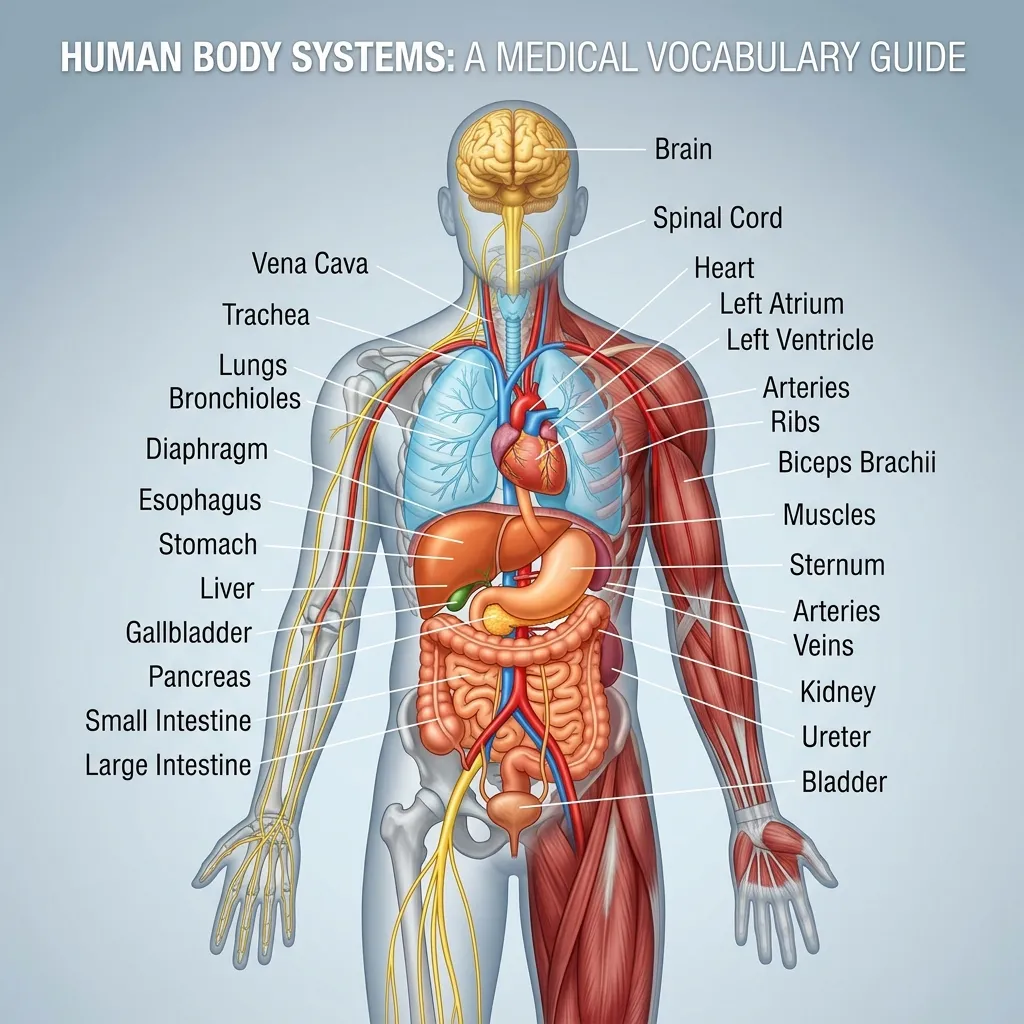 One of the most effective ways to build medical vocabulary is to organize terms by body system. This contextual approach helps you connect terminology to real anatomical structures and clinical scenarios.
Skeletal System
The skeletal system involves bones, joints, cartilage, and ligaments. Key root words include osteo- (bone), arthr(o)- (joint), and chondr(o)- (cartilage).
- Osteoporosis: loss of bone density
- Arthritis: inflammation of a joint
- Fracture: break in a bone
- Osteomyelitis: bone marrow infection
Muscular System
Root words: my(o)- or muscul(o)- (muscle), ten(o)- (tendon)
- Myopathy: disease of the muscle
- Tendinitis: inflammation of a tendon
- Atrophy: wasting away of muscle
- Dystrophy: progressive muscle degeneration
Cardiovascular System
Root words: cardi(o)- (heart), angi(o)- (vessel), hem(o/ato)- (blood)
- Myocardial infarction: heart attack (death of heart muscle)
- Hypertension: high blood pressure
- Atherosclerosis: hardening of arteries due to plaque
- Arrhythmia: irregular heart rhythm
For a deeper look at cardiovascular anatomy, see our guide on Basics of Human Anatomy.
Respiratory System
Root words: pulmon(o)- (lung), pneum(o)- (air or lung), bronch(o)- (bronchi)
- Pneumonia: infection of the lungs
- Bronchitis: inflammation of the bronchi
- Dyspnea: difficulty breathing
- Hypoxia: low oxygen levels in the body
Digestive System
Root words: gastr(o)- (stomach), hepat(o)- (liver), col(o)- (colon)
- Gastritis: inflammation of the stomach
- Hepatitis: inflammation of the liver
- Colitis: inflammation of the colon
- Dysphagia: difficulty swallowing
Nervous System
Root words: neur(o)- (nerve), encephal(o)- (brain), myel(o)- (spinal cord)
- Neuralgia: nerve pain
- Encephalitis: inflammation of the brain
- Meningitis: inflammation of the meninges (membranes around the brain)
- Neuropathy: nerve disease or damage
Endocrine System
Root words: adren(o)- (adrenal gland), thyr(o)- (thyroid), pancreat(o)- (pancreas)
- Hypothyroidism: underactive thyroid
- Diabetes mellitus: impaired insulin function leading to elevated blood glucose
- Adrenocortical insufficiency: underactive adrenal glands (also known as Addison’s disease)
Integumentary System
Root words: derm(a/o)- (skin), trich(o)- (hair), onych(o)- (nail)
- Dermatitis: inflammation of the skin
- Melanoma: malignant tumor of melanocytes (skin pigment cells)
- Alopecia: hair loss
- Onychomycosis: fungal infection of the nail
Urinary System
Root words: nephr(o)- (kidney), uret(o)- (ureter), cyst(o)- (bladder)
- Nephritis: inflammation of the kidney
- Urinary tract infection (UTI): bacterial infection in the urinary system
- Cystitis: inflammation of the bladder
- Renal failure: loss of kidney function
Reproductive System
Root words: gyn(o)- or metr(o)- (uterus), orchid(o)- (testis), oophor(o)- (ovary)
- Endometriosis: growth of uterine tissue outside the uterus
- Orchitis: inflammation of the testes
- Dysmenorrhea: painful menstruation
- Oophorectomy: surgical removal of an ovary
Common Medical Terms and Definitions for Beginners
This glossary of frequently encountered terms uses plain language to build your confidence quickly:
|
Term |
Definition |
|---|---|
|
Acute |
Sudden onset, short duration |
|
Chronic |
Long-term, persisting condition |
|
Benign |
Non-cancerous |
|
Malignant |
Cancerous; likely to spread |
|
Prognosis |
Expected outcome of a disease |
|
Diagnosis |
Identification of a disease or condition |
|
Etiology |
Cause of a disease |
|
Idiopathic |
Of unknown cause |
|
Pathology |
Study of disease |
|
Systemic |
Affecting the whole body |
|
Prophylaxis |
Prevention of disease |
|
Morbidity |
Rate of disease in a population |
|
Mortality |
Death rate from a specific cause |
Understanding Medical Procedures and Diagnoses
 Understanding medical procedures and diagnoses becomes much easier when you know the language healthcare professionals use. A solid medical terminology guide helps you interpret procedure names, diagnostic terms, and clinical reports with confidence. Learning these common medical terms and definitions also improves communication with healthcare providers and supports informed healthcare decisions.
Surgical Procedure Suffixes
- -ectomy: surgical removal (appendectomy, mastectomy, tonsillectomy)
- -ostomy: creating a permanent opening (colostomy, tracheostomy)
- -otomy: cutting into (laparotomy, craniotomy)
- -plasty: surgical repair or reconstruction (rhinoplasty, arthroplasty)
Diagnostic Tests and Imaging
Understanding diagnostic terminology helps patients and students make sense of test orders and reports.
- Biopsy: removal and examination of tissue
- Electrocardiogram (ECG/EKG): recording of heart electrical activity
- Magnetic Resonance Imaging (MRI): detailed imaging using magnetic fields
- Computed Tomography (CT): cross-sectional X-ray imaging
- Urinalysis: laboratory testing of urine
- Complete Blood Count (CBC): measurement of blood components
Pharmacology Basics: Medication Terminology
Medical vocabulary extends into the pharmacy. Understanding drug classifications and naming conventions makes prescriptions and drug charts significantly easier to navigate. For a comprehensive overview, check out our full post on Pharmacology Basics for Beginners.
Drug Classification Suffixes
Many drug classes share a recognizable suffix, making it easier to identify a medication’s function:
- -olol: beta-blockers (e.g., propranolol, atenolol)
- -pril: ACE inhibitors (e.g., lisinopril, enalapril)
- -statin: cholesterol-lowering drugs (e.g., atorvastatin, rosuvastatin)
- -cillin: penicillin antibiotics (e.g., amoxicillin, flucloxacillin)
- -zole: antifungals or proton pump inhibitors (e.g., omeprazole, fluconazole)
Routes of Administration
- Oral (PO): taken by mouth
- Intravenous (IV): injected into a vein
- Intramuscular (IM): injected into muscle
- Subcutaneous (SC): injected under the skin
- Topical: applied to the skin surface
- Sublingual (SL): dissolved under the tongue
How to Master Medical Vocabulary: Proven Tips and Strategies
Building medical vocabulary is a skill—and like any skill, it improves with the right techniques.
Use Flashcards and Spaced Repetition
Spaced repetition systems (SRS) like Anki are widely used in medical education. According to a 2019 study published in Medical Education, students using spaced repetition showed significantly better long-term retention compared to traditional rereading methods. Create flashcards for prefixes, suffixes, and root words and review them daily.
Learn in Context, Not in Isolation
Reading case studies, clinical notes, or patient histories exposes you to medical vocabulary in real settings. This contextual learning approach reinforces meaning far more effectively than memorizing word lists alone. For guidance on how to approach medical learning more broadly, read our guide on How to Study Medicine Effectively.
Use Trusted Online Resources
Reliable external resources accelerate your learning:
- Merriam-Webster Medical Dictionary provides clear, accessible definitions for thousands of clinical terms.
- MedlinePlus (maintained by the U.S. National Library of Medicine) offers patient-friendly explanations of conditions, procedures, and medications.
Build a Personal Glossary
Keep a running document or notebook of unfamiliar terms you encounter. Writing a term down, defining it in your own words, and using it in a sentence is one of the most effective retention strategies available.
Advanced Concepts: Terminology in Medical Specialties
 Once you’ve grasped the fundamentals, you can explore terminology specific to medical specialties.
Oncology
Oncology deals with the diagnosis and treatment of cancer. Key terms include:
- Carcinoma: cancer originating in epithelial tissue
- Sarcoma: cancer of connective tissue
- Metastasis: spread of cancer to other parts of the body
- Neoadjuvant therapy: treatment given before primary therapy to reduce tumor size
Cardiology
Beyond the basics of cardiovascular terminology, cardiologists use terms like:
- Ejection fraction: percentage of blood pumped out of the heart per beat
- Stenosis: narrowing of a valve or vessel
- Percutaneous coronary intervention (PCI): catheter-based procedure to open blocked arteries
Neurology
Neurological terminology describes disorders of the brain and nervous system:
- Ischemic stroke: loss of blood supply to the brain
- Demyelination: destruction of the myelin sheath surrounding nerves
- Electroencephalogram (EEG): recording of brain electrical activity
Conclusion
Medical terminology is not something you learn overnight—but it is something anyone can learn with the right approach. Start with prefixes, suffixes, and root words. Apply those building blocks to body systems. Practice with real clinical language and trusted resources. Over time, terms that once seemed impenetrable will become second nature.
Understanding medical language changes how you interact with healthcare. It builds confidence in clinical environments, supports better patient outcomes, and opens doors to deeper learning across all medical disciplines. Whether you’re taking your first steps into healthcare or expanding your existing knowledge, this medical terminology guide gives you a framework that will serve you for years to come.
Keep learning, keep building, and revisit this medical vocabulary guide whenever you need a reference point. The language of medicine is vast—but every expert started exactly where you are now.
Frequently Asked Questions
1. What is the best way for beginners to start learning medical terminology?
The best way to use a medical terminology guide is to begin with common prefixes, suffixes, and root words. These building blocks appear repeatedly across common medical terms and definitions, making it easier for medical terminology for beginners to understand new vocabulary.
2. Why is medical terminology important for healthcare professionals?
A medical terminology guide provides a standardized language for healthcare professionals. It improves communication, reduces clinical errors, and ensures accurate understanding of common medical terms and definitions across medical specialties.
3. What are the most common medical prefixes to know?
Some of the most common prefixes include hypo- (below normal), hyper- (above normal), brady- (slow), tachy- (fast), a-/an- (without), and peri- (surrounding). Every medical vocabulary guide covers these essential prefixes because they appear in hundreds of medical terms.
4. How long does it take to learn basic medical terminology?
With consistent study, medical terminology for beginners can build a solid foundation in 8–12 weeks. Using a medical terminology guide, flashcards, and regular practice helps speed up learning.
5. What is the difference between a prefix, root word, and suffix in medical terms?
A prefix comes before the root and describes location or status; the root identifies the body part, and the suffix indicates a condition, disease, or procedure. Understanding these components is essential when learning common medical terms and definitions.
6. Are medical terms always derived from Latin and Greek?
Most terms in any medical terminology guide originate from Latin or Greek. Some are derived from eponyms or modern abbreviations, but Latin and Greek remain the foundation of medical language.
7. What is the difference between -ectomy, -ostomy, and -otomy?
An -ectomy means surgical removal, an -ostomy means creating an opening, and an -otomy means making an incision. These are among the common medical terms and definitions every healthcare student should know.
8. How can I remember medical terms more effectively?
Use a medical vocabulary guide, spaced-repetition flashcards, and real clinical examples. Reading case studies and creating a personal glossary makes medical terminology for beginners easier to remember.
9. Is medical terminology the same across all countries?
Most medical terminology is internationally recognized because it is based on Latin and Greek roots. However, some regional differences exist, making a comprehensive medical terminology guide useful for global healthcare communication.
10. Can patients benefit from learning medical terminology?
Yes. A medical terminology guide helps patients understand common medical terms and definitions, communicate more effectively with healthcare providers, interpret test results, and make informed healthcare decisions.
