
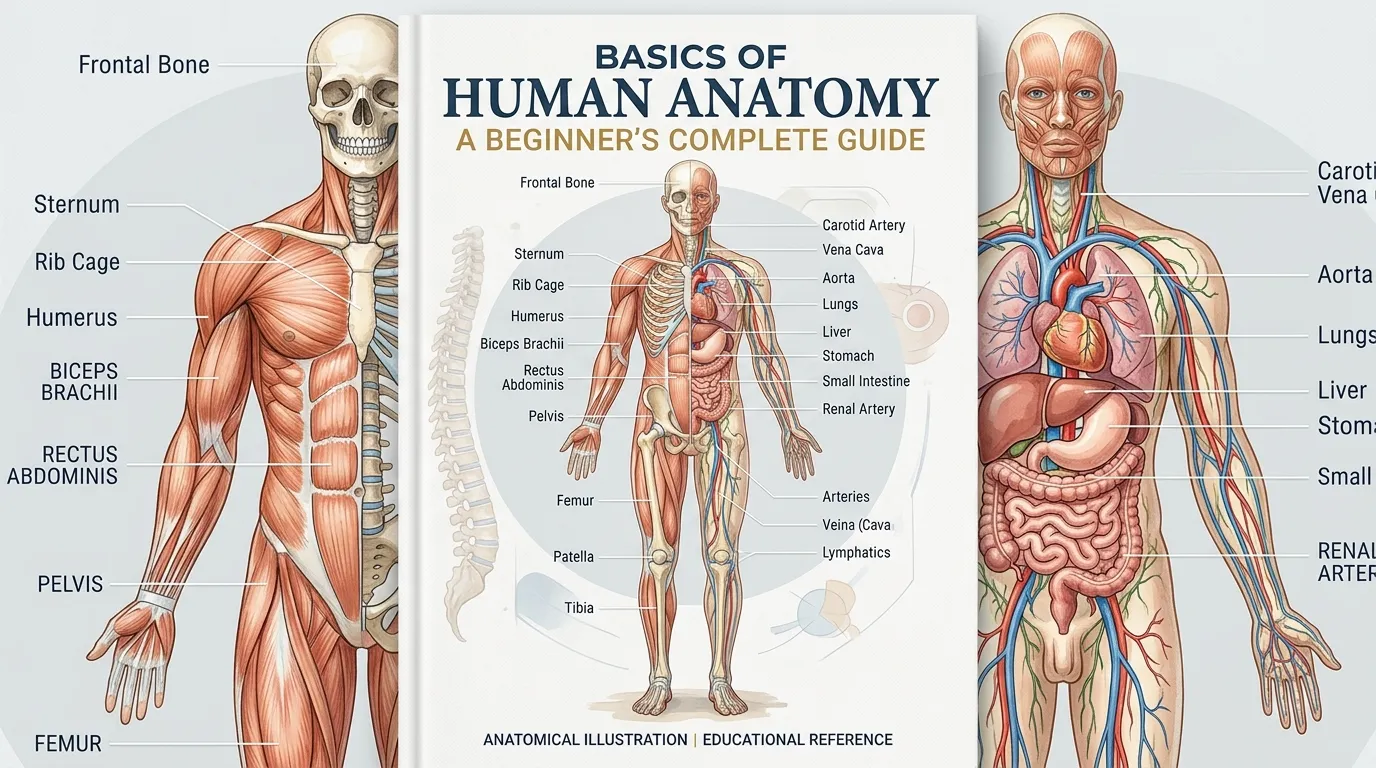
Learn the basics of human anatomy, including an overview of body systems and their functions. This guide explains how organs and structures work together, providing beginners with a clear foundation for understanding the human body and its organization.
The basics of human anatomy cover how the body is organized—from atoms and cells to tissues, organs, and 11 major systems. This introduction to human anatomy explains levels of structural organization, body systems overview, anatomical terminology, and homeostasis, giving beginners a clear foundation for medical study and everyday health understanding.
Your body is a marvel of organization. Trillions of cells work together every second to keep your heart beating, your lungs breathing, and your brain thinking—all without a single conscious command from you. Understanding how this happens starts with the basics of human anatomy.
Human anatomy is the study of the body’s structure—what each part looks like, where it sits, and how it connects to everything else. It forms the bedrock of medicine, nursing, physiotherapy, and countless health careers. But you don’t need to be a future doctor to benefit. Knowing how your body works helps you make smarter health decisions, follow medical advice, and understand what’s happening when something goes wrong.
This introduction to human anatomy walks you through everything a beginner needs to know. You’ll learn how the body is organized from the smallest atom to the whole person, get a clear human body systems overview, and master the directional terms doctors use every day. We’ll also explore homeostasis—the body’s remarkable balancing act—and show why this knowledge matters in real life.
Whether you’re a student preparing for exams, a curious learner, or someone planning a career in healthcare, this guide on human anatomy for beginners gives you a solid, well-structured starting point.
What Is Human Anatomy and Why Does It Matter?
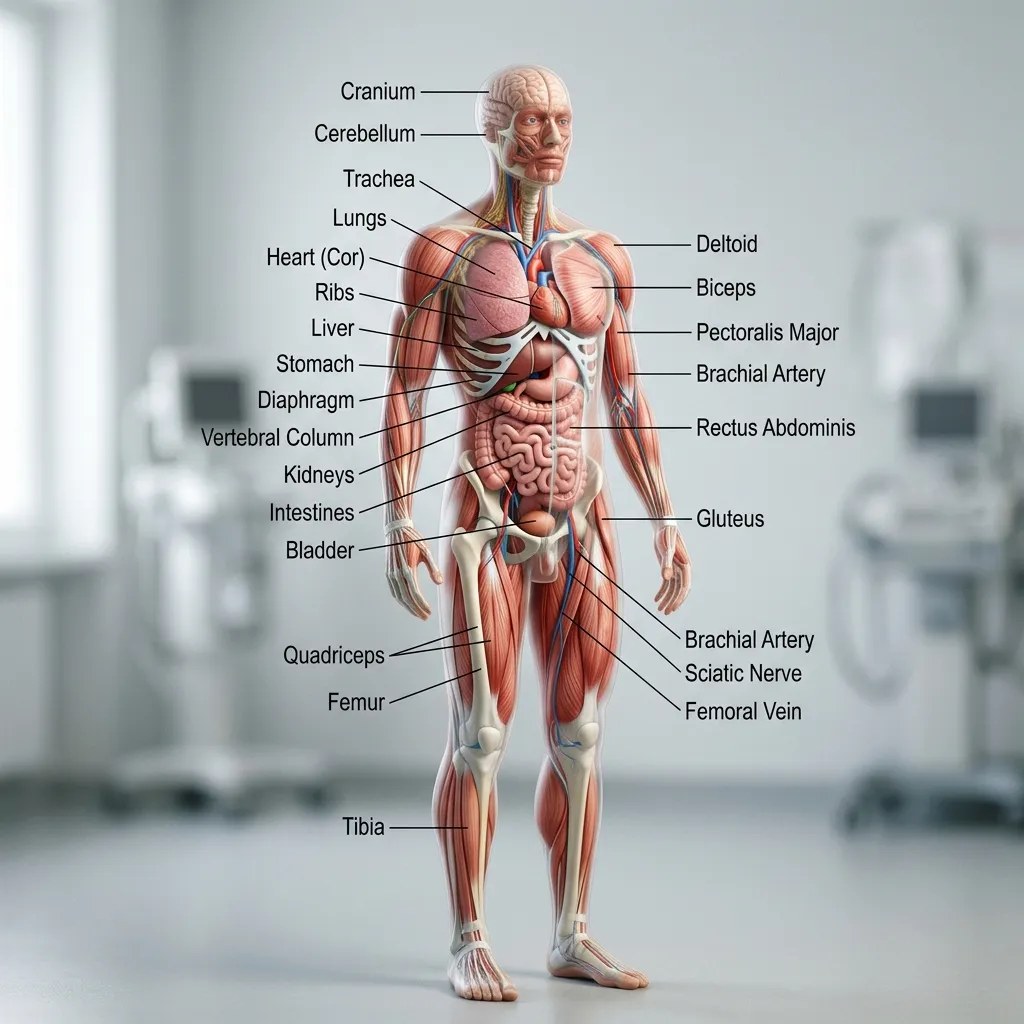 Human anatomy is the scientific study of the body’s structures and how they relate to one another. The word “anatomy” comes from the Greek anatomē, meaning “to cut up”—a nod to the dissection methods early scholars used to learn what lies beneath the skin.
The study of anatomy stretches back thousands of years. Ancient Egyptian and Greek physicians made early observations, but the field took a giant leap forward in 1543 when Andreas Vesalius published De Humani Corporis Fabrica. His detailed, accurate drawings corrected centuries of error and earned him the title “father of modern anatomy.” Today, advanced imaging like MRI and CT scans let us study the living body in extraordinary detail.
Why Should Beginners Study Human Anatomy?
Anatomy matters for different people in different ways:
- For medical and health students: Anatomy is the foundation of clinical practice. You cannot examine a patient, interpret a scan, or perform a procedure without knowing where structures sit and how they function. Strong anatomical knowledge underpins the clinical skills that medical students develop throughout training.
- For fitness and wellness enthusiasts: Understanding muscles and joints helps you exercise safely, prevent injury, and train more effectively.
- For general knowledge: Knowing your body helps you describe symptoms accurately, understand a diagnosis, and make informed choices about your health.
Anatomy turns the body from a mystery into a map. Once you learn that map, everything from a doctor’s explanation to a fitness routine starts to make sense.
What Are the Levels of Structural Organization?
The human body is built like a set of nested building blocks. Each level combines to form the next, growing in complexity from simple chemicals to a complete living person. Understanding these six levels is the first step in any introduction to human anatomy.
The Chemical Level
At the most basic level sit atoms—tiny particles like hydrogen, oxygen, carbon, and nitrogen. Atoms join to form molecules, such as water, proteins, and DNA. These molecules drive every chemical reaction that keeps you alive.
The Cellular Level
Molecules combine to form cells, the smallest units of life. The human body contains an estimated 37 trillion cells. Each cell carries out specific jobs—a nerve cell sends signals, while a muscle cell contracts to create movement.
The Tissue Level
Groups of similar cells working together form tissues. The body has four basic tissue types: epithelial (covering and lining), connective (support and binding), muscular (movement), and nervous (communication).
The Organ Level
When two or more tissue types combine to perform a shared function, they form an organ. The heart, lungs, brain, and stomach are all organs. The heart, for example, contains muscle tissue, connective tissue, and nervous tissue all working in concert.
The Organ System Level
Organs that cooperate to perform major functions form an organ system. The digestive system, for instance, includes the stomach, intestines, liver, and pancreas. The human body has 11 major organ systems.
The Organismal Level
Finally, all 11 systems working together create the organism—the complete, living human being. Every level depends on the ones below it, which is why a problem at the cellular level can affect the entire body.
Human Body Systems Overview: The 11 Major Systems
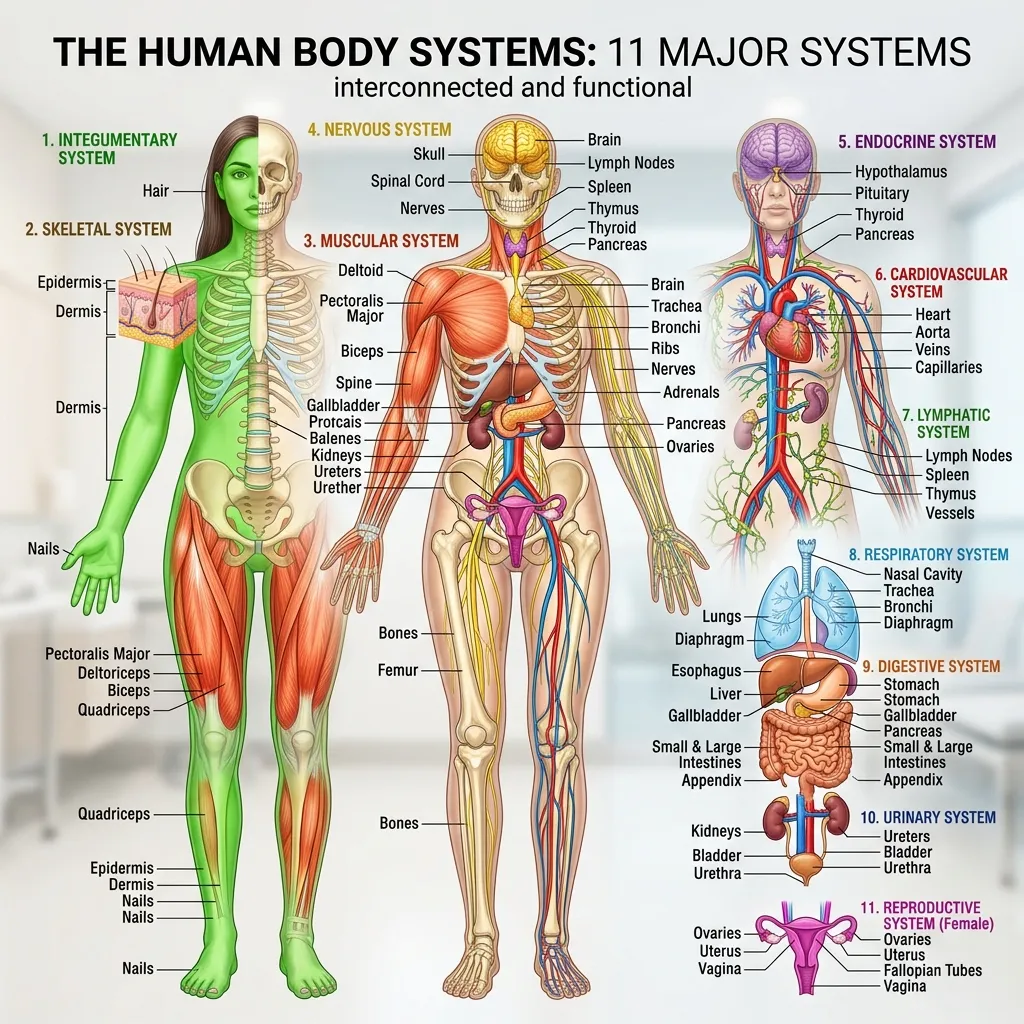 A clear human body systems overview is essential for any beginner. Each of the 11 systems has a distinct role, yet they all work together to keep you alive and functioning. Here’s what each one does.
Skeletal System
The skeletal system is the body’s framework. An adult human skeleton has 206 bones that support the body, protect organs, and allow movement. Major bones include the femur (the longest bone), the skull (which protects the brain), and the rib cage (which shields the heart and lungs). Bones also store minerals like calcium and produce blood cells in their marrow.
Muscular System
The muscular system powers all movement. It has three muscle types: skeletal muscle (voluntary, attached to bones), cardiac muscle (found only in the heart), and smooth muscle (involuntary, in organs like the intestines). Major muscles include the biceps, quadriceps, and the diaphragm, which drives breathing.
Nervous System
The nervous system is the body’s control center. It splits into the central nervous system (the brain and spinal cord) and the peripheral nervous system (the nerves branching throughout the body). Specialized cells called neurons transmit electrical signals at remarkable speed, controlling everything from thought to reflex.
Endocrine System
The endocrine system regulates the body using chemical messengers called hormones. Glands like the thyroid, pancreas, and adrenal glands release hormones into the blood to control growth, metabolism, mood, and reproduction. Because hormones travel through the bloodstream, their effects are slower but longer-lasting than nerve signals.
Cardiovascular System
The cardiovascular system transports blood throughout the body. It consists of the heart, blood vessels (arteries, veins, and capillaries), and blood. The heart pumps roughly 2,000 gallons of blood daily, delivering oxygen and nutrients to cells while carrying away waste.
Lymphatic System
The lymphatic system supports immunity and fluid balance. It includes lymph (a clear fluid), lymph vessels, and lymph nodes. This system drains excess fluid from tissues, filters out pathogens, and houses white blood cells that defend against infection.
Respiratory System
The respiratory system handles gas exchange. Air travels through the airways into the lungs, where oxygen enters the blood and carbon dioxide leaves it. Key structures include the trachea, bronchi, and millions of tiny air sacs called alveoli.
Digestive System
The digestive system breaks down food and absorbs nutrients. It runs from the mouth through the esophagus, stomach, and intestines, with help from the liver, pancreas, and gallbladder. This system converts the food you eat into the energy and building blocks your cells need.
Urinary System
The urinary system removes waste and balances fluids. The kidneys filter blood to produce urine, which travels through the ureters to the bladder before leaving the body. The kidneys also regulate blood pressure and maintain the right balance of salts and water.
Reproductive System
The reproductive system enables the creation of new life. The male system produces sperm, while the female system produces eggs and supports pregnancy. These systems differ significantly between sexes but share the goal of reproduction.
Integumentary System
The integumentary system is your body’s outer barrier. It includes the skin, hair, and nails. The skin—the body’s largest organ—protects against injury and infection, regulates temperature, and lets you sense touch, pressure, and temperature.
How Do You Understand Anatomical Terminology and Orientation?
Doctors and scientists use a shared language to describe the body precisely. This terminology removes confusion—”the pain is on the left” can be ambiguous, but anatomical terms never are. Learning these terms early makes the rest of the human anatomy far easier to follow.
What Is the Anatomical Position?
All anatomical descriptions assume the body is in the standard anatomical position: standing upright, facing forward, with arms at the sides and palms facing forward. This consistent reference point ensures everyone describes locations the same way, regardless of how the body is actually positioned.
What Are the Main Directional Terms?
Directional terms describe where one body part sits relative to another:
- Superior / Inferior: Above / below (the head is superior to the chest).
- Anterior / Posterior: Front/back (the breastbone is anterior to the spine).
- Medial / Lateral: Toward / away from the midline (the nose is medial to the ears).
- Proximal / Distal: Closer to / farther from the point of attachment (the elbow is proximal to the wrist).
- Superficial / Deep: Near the surface / farther inside (the skin is superficial to the muscles).
What Are the Body Planes and Sections?
Anatomists divide the body using imaginary flat surfaces called planes:
- Sagittal plane: Divides the body into left and right portions.
- Frontal (coronal) plane: Divides the body into front and back portions.
- Transverse plane: Divides the body into upper and lower portions.
These planes matter most when reading medical scans, which display the body in cross-sections.
What Are the Body Cavities?
The body has spaces called cavities that house and protect organs. The two main cavities are the dorsal cavity (containing the brain and spinal cord) and the ventral cavity. The ventral cavity splits into the thoracic cavity (housing the heart and lungs) and the abdominopelvic cavity (housing the digestive and reproductive organs).
What Are the Cellular and Tissue Basics?
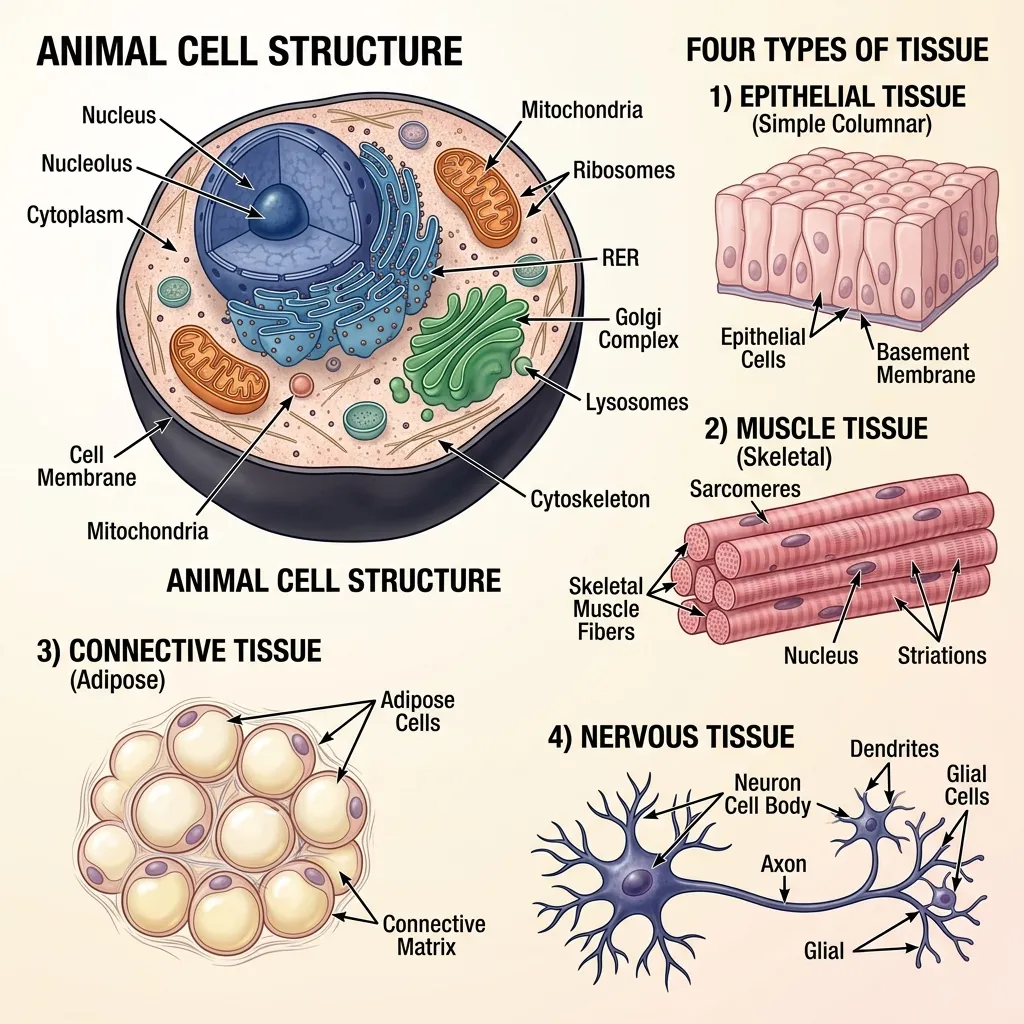 Since cells and tissues form the foundation of every organ, a quick look at them strengthens your grasp of the bigger picture.
Cells contain tiny structures called organelles, each with a specific job. The nucleus stores DNA and directs the cell’s activities. Mitochondria generate energy. Ribosomes build proteins. The cell membrane controls what enters and leaves. Together, these parts keep the cell—and by extension, the whole body—running smoothly.
As noted earlier, four tissue types build every organ. Epithelial tissue covers surfaces and lines cavities, acting as a protective barrier. Connective tissue—including bone, blood, and fat—supports and binds other tissues. Muscle tissue contracts to produce movement. Nervous tissue carries electrical signals for rapid communication. Recognizing these four types makes organ function far easier to understand.
How Does the Body Maintain Homeostasis?
Homeostasis is the body’s ability to keep its internal environment stable despite changes outside. Your body temperature, blood sugar, and fluid levels all stay within narrow, healthy ranges thanks to this constant balancing act. Without homeostasis, even small disruptions could be fatal.
How Do Feedback Mechanisms Work?
The body maintains balance using two types of feedback:
- Negative feedback reverses a change to restore balance. It’s by far the most common type. When you get too hot, your body sweats to cool down. When blood sugar rises after a meal, insulin lowers it. The response counteracts the original change.
- Positive feedback amplifies a change to complete a process. It’s rarer and usually tied to specific events. During childbirth, for example, contractions trigger hormones that cause even stronger contractions until delivery.
What Are Some Examples of Homeostatic Regulation?
Everyday examples show homeostasis at work. Your body keeps its core temperature near 98.6°F (37°C) by sweating when hot and shivering when cold. It regulates blood glucose using insulin and glucagon. It also balances water and salt levels through the kidneys. Each of these processes happens automatically, around the clock.
Why Does Understanding Anatomy Matter in Real Life?
The basics of human anatomy aren’t just academic—they have practical value in many areas of life.
In medicine, anatomy is non-negotiable. Clinicians rely on it to examine patients, diagnose conditions, and perform procedures safely. This knowledge connects directly to the clinical reasoning students build during training, and pairs well with strong study habits covered in our guide on how to study medicine effectively.
For fitness and health, understanding your muscles and joints helps you exercise with proper form, avoid injury, and recover well. It also supports broader wellness goals tied to the importance of preventive healthcare, since knowing your body makes it easier to spot warning signs early.
In everyday life, anatomy helps you communicate with healthcare providers, understand a diagnosis, and make sense of health news. When you know the difference between a tendon and a ligament, or where your kidneys sit, you become a more informed and active participant in your own care—a key part of strong patient care guidelines.
Conclusion
The basics of human anatomy come down to a few core ideas: the body is organized into six levels of structure, built from 11 major systems, described using precise terminology, and kept stable through homeostasis. Master these foundations, and you’ll have the framework to understand almost any topic in health and medicine.
Start small. Pick one body system this week—maybe the cardiovascular or skeletal system—and learn its main parts and functions. Then move to the next. Use diagrams, label structures from memory, and connect each part to its real-world role. Little by little, the body’s map will become second nature.
Anatomy is the gateway to a deeper understanding of health, fitness, and medicine. The foundation you build today will support everything you learn tomorrow. For more learning resources, explore trusted references like Kenhub and the National Library of Medicine, both of which offer excellent introductions to human anatomy for beginners.
Frequently Asked Questions
1. What are the basics of human anatomy for beginners?
The basics of human anatomy for beginners include the six levels of structural organization (chemical, cellular, tissue, organ, organ system, and organismal), the 11 major body systems, anatomical terminology, and homeostasis. Mastering these four areas gives you a solid foundation to build on.
2. How many body systems are there in human anatomy?
The human body has 11 major organ systems: skeletal, muscular, nervous, endocrine, cardiovascular, lymphatic, respiratory, digestive, urinary, reproductive, and integumentary. Each system performs distinct functions, but they all work together to keep the body alive and healthy.
3. What is the difference between anatomy and physiology?
Anatomy is the study of the body’s structures—what parts look like and where they sit. Physiology is the study of how those structures function. The two are closely linked, since structure usually determines function. Most courses teach them together.
4. What are the four basic types of tissue?
The four basic tissue types are epithelial (covers surfaces and lines cavities), connective (supports and binds, including bone and blood), muscular (produces movement), and nervous (transmits electrical signals). Every organ in the body is built from a combination of these four tissues.
5. What is homeostasis in simple terms?
Homeostasis is the body’s ability to keep its internal conditions stable and balanced. For example, it keeps your temperature near 98.6°F and your blood sugar within a healthy range. The body uses feedback mechanisms to correct any changes automatically.
6. Why is anatomical position important?
Anatomical position—standing upright, facing forward, with palms forward—gives everyone a consistent reference point. It ensures that directional terms like “anterior” or “lateral” always mean the same thing, removing confusion when describing the location of body parts.
7. What is the largest organ in the human body?
The skin is the largest organ in the human body. As part of the integumentary system, it protects against injury and infection, regulates body temperature, and allows you to sense touch, pressure, and temperature. An adult’s skin covers about 20 square feet.
8. How many bones are in the adult human body?
The adult human body has 206 bones. Babies are born with around 300 bones, but many fuse together as they grow. The skeletal system supports the body, protects vital organs, enables movement, stores minerals, and produces blood cells.
9. Is human anatomy hard to learn for beginners?
Human anatomy involves a lot of memorization, which can feel challenging at first. However, breaking it into the levels of organization and tackling one body system at a time makes it manageable. Using diagrams, drawing from memory, and linking structures to functions speeds up learning.
10. What is the best way to start learning human anatomy?
The best way to start is to learn the levels of structural organization first, then study one body system at a time. Use visual tools like atlases and 3D models, label diagrams from memory, and connect each structure to its real-world function. Consistency beats cramming.
